Artist: Fernando Guzmán Monroy
Artist Nationality: Mexican
Artist Dates: B. 1941
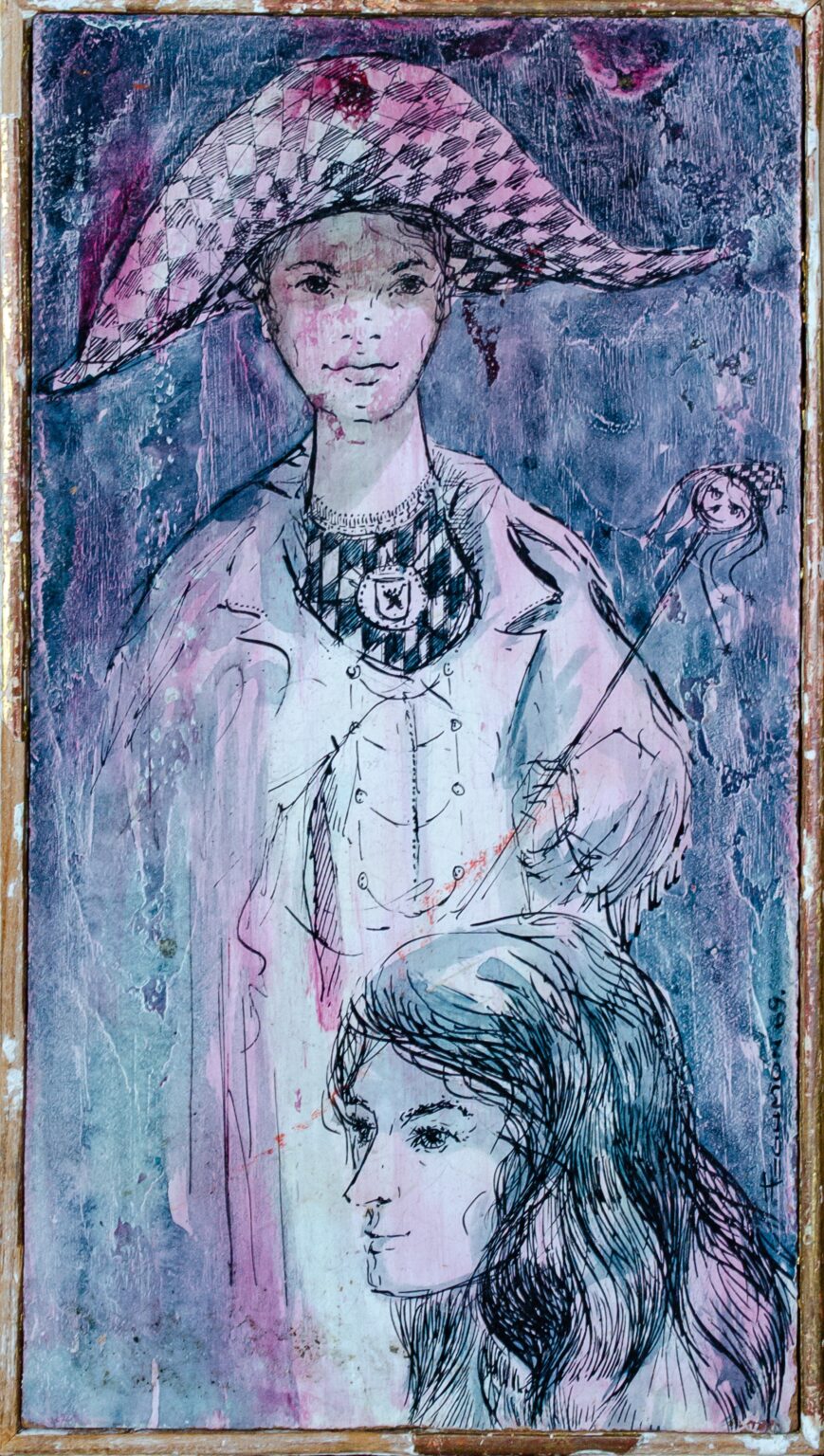
Title: El Bufon
Date: 1969
Condition: Good condition
Medium: Acrylic and mixed media
Dimensions: 7 7/8 x 4 1/3 x 1/2 in.
Estimated Value: $500
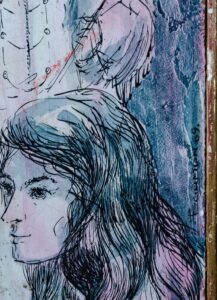
Signature/Markings: Signed and lower right
Fernando Guzmán Monroy’s "El Bufón" (1969) is a lyrical fusion of drawing and watercolor that portrays a jester-like figure paired with a contemplative female profile. Executed in delicate ink lines and soft washes of indigo, violet, and pink, the work balances precision with emotional ambiguity. The overlapping figures suggest duality—the performer and the observer, the mask and the self. Guzmán Monroy’s linear style, refined yet expressive, reflects the rigorous draftsmanship taught at Mexico City’s Royal Academy of San Carlos, where he trained amid a modernist shift in the late 1950s and 1960s.
The bufón (jester) is a potent symbol in Mexican and European visual traditions. Guzmán Monroy transforms the figure from mere entertainer to introspective philosopher, the checkered costume and heraldic motifs hinting at irony and self-awareness. Beneath the theatrical façade lies a mood of quiet melancholy, evoking the dual nature of the payaso in Mexican folk culture—a performer whose humor masks vulnerability. The weathered texture and luminous, irregular coloration connect the piece to vernacular devotional imagery such as retablos and ex-votos, grounding it in the expressive immediacy of Mexican folk art even as it maintains academic poise.
At San Carlos, Guzmán Monroy was part of a generation that sought to move beyond the grand narratives of muralism toward more personal, psychological expression. "El Bufón" exemplifies this transition: technically rigorous yet intimate and introspective. His use of the jester motif parallels the work of contemporaries like Francisco Corzas, José Luis Cuevas, and Rafael Coronel, who each explored theatrical masks and human fragility as symbols of modern identity. Like them, Guzmán Monroy’s art balances irony and tenderness, positioning the figure as both performer and truth-teller.
"El Bufón" bridges Mexico’s folk visual heritage and the existential modernism emerging from the Royal Academy of San Carlos in the 1960s. In its restrained palette, lyrical line, and emotional complexity, the work redefines national identity not through heroic imagery but through introspection. The jester becomes an emblem of the artist himself—poised between laughter and reflection, tradition and reinvention.
About Fernando Guzmán Monroy: Fernando Guzmán Monroy was born in Pátzcuaro, Michoacan, Mexico on November 1, 1941. He studied and graduated from the Royal Academy of San Carlos (Academia de San Carlos). The artist commonly signed his paintings FEGUMON based on a the combination of letters from his full name Fernando Guzmán Monroy.
GROUP EXHIBITIONS:
Royal Academy of San Carlos, Mexico City, 1961-1964.
School of Fine Arts, Guadalajara, Jalisco, 1964.
I.N.J.M., Mexico City, 1965-1967.
Mexican-North American Cultural Relations, Mexico City, 1967. Autonomous University of Aguascalientes, Ags. 1968.
Galleries of Culture, Tula, Hgo. 1968.
Hidolguense Institute of Fine Arts, Pachuca, Hgo. 1968.
New Values, Chapultepec Galleries, Mexico City.
Provenance:
Private New York Collection
Exhibition History:
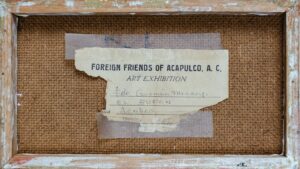
Friends of Acapulco A.C. Exhibition label verso
Publication History: