
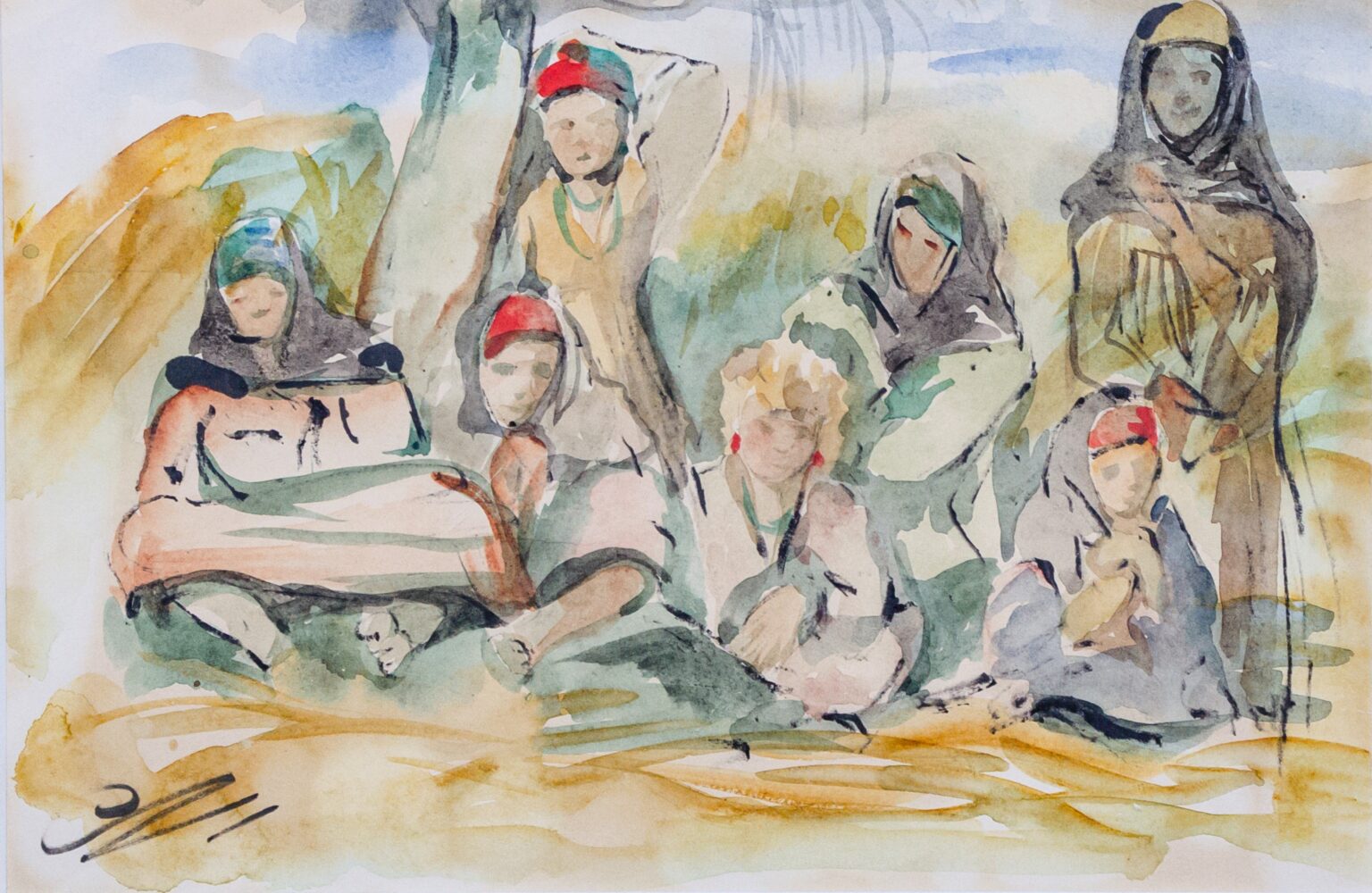


Artist: Simon Samsonian
Artist Nationality: Armenian-Egyptian
Artist Dates: 1912-2003
Title: Untitled (figures)
Date: 20th Century
Condition: Good, not examined outside of the frame
Medium: Watercolor on paper
Dimensions: approx. 12 x 16 in. framed
Estimated Value: $1,250
Signature/Markings: Signed lower left
Simon Samsonian (c. 1912–2003) was an Armenian-Egyptian painter whose life and work were shaped by displacement, survival, and cultural exchange across the Mediterranean. Born in the Black Sea port town of Samson in northern Turkey, he was orphaned during the Armenian genocide of 1915 and survived through a series of rescue efforts by Greek nuns and international relief organizations. After periods in orphanages in İzmir, Istanbul, and on the Greek island of Syra, he eventually settled in Egypt, where he would develop his artistic career and become a significant figure in the Armeno-Egyptian artistic community.
Samsonian studied art at the Leonardo Da Vinci School in Cairo between 1932 and 1936 and soon began exhibiting widely. His first solo exhibition took place in Cairo in 1936, and he participated regularly in the city’s annual salons as well as major exhibitions of Armenian-Egyptian artists. A formative trip to Europe in 1950—during which he studied the artistic heritage of Italy, Paris, and London—marked a turning point in his practice. While maintaining his personal style of stylized realism, his work began to incorporate elements of Fauvism and Cubism, producing a distinctive visual language. During the 1950s and 1960s, widely regarded as the most accomplished phase of his career, he created notable works such as *The Caliph Omar Ibn al-Khattab Praying in Jerusalem* (1960), becoming one of the most celebrated works of modern Egyptian art.
Samsonian received major recognition in Egypt, including first prizes at the Cairo Salon in 1964, 1965, and 1967, establishing him as one of the most prominent Armeno-Egyptian artists of the twentieth century. In 1968 he emigrated to New York, where he continued exhibiting in venues such as the Armenian Benevolent Union gallery and the Lynn Kottler Gallery on Madison Avenue, while also showing in Toronto and at the City University of New York. In 1973 he realized a lifelong ambition by visiting Armenia and presenting a retrospective exhibition in Yerevan. Though he later lived more quietly, his work continued to be rediscovered, culminating in a 2013 posthumous exhibition at the Armenian Museum of America titled *A Master Rediscovered*.
Provenance:
Private New York Collection
Exhibition History:
Publication History: