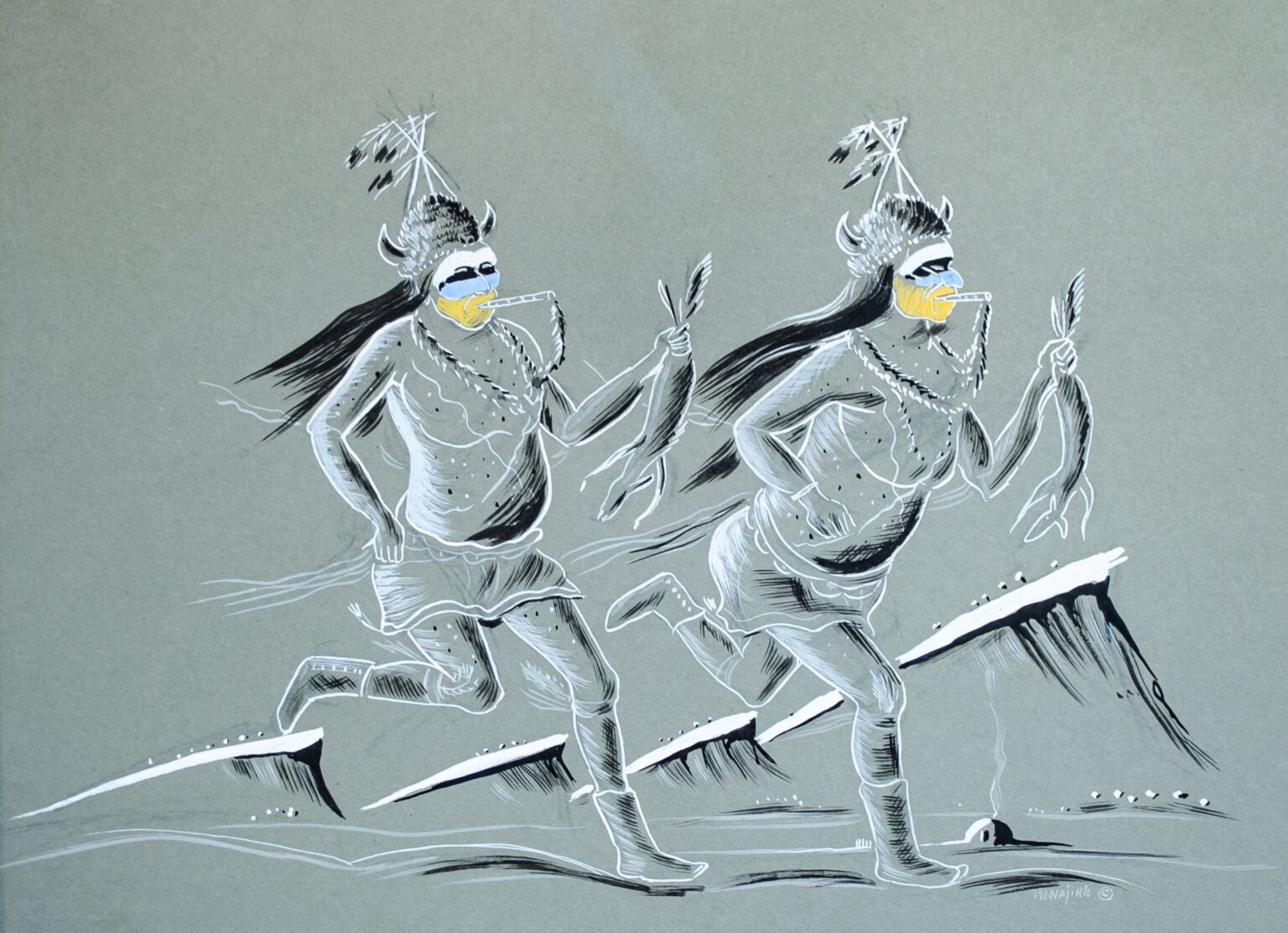


Artist: Andrew Tsinajinnie
Artist Nationality: Diné (Navajo)
Artist Dates: 1916-2000
Title: Untitled
Date: n.d.
Condition: Good condition; mat burn apparent
Medium: Gouache on paper board
Dimensions: 15 x 20 inches
Estimated Value: $1,000
Signature/Markings: Signed lower right
Andrew Tsinajinnie, called Andy by those who knew him, was a painter, illustrator, and printmaker of the Diné (Navajo) people whose reputation places him among the most accomplished Native American artists of his century. His style shifted often across his career, yet the people, ceremonies, and daily routines of the Navajo remained his constant theme. His surname appears in many spellings, such as Tsihnahjinnie and Tsinajinie, and he went by the nicknames Yazzie Bahe and Little Grey, the second of which translates his family name.
Born November 1916 at Rough Rock, close to Chinle, Arizona, he began drawing as a small child while growing up tending sheep and riding horses, a life he cherished and would return to again and again on canvas. Sent to the Fort Apache Indian School, he fled more than once, reportedly over how staff treated students, and was finally permitted to go home. In his teens he entered the Santa Fe Indian School and joined the earliest group of students taught by Dorothy Dunn, who had created "The Studio" as a program for nurturing young Native artists, where Dunn counted him among her finest pupils. He later studied at the California College of Arts and Crafts in Oakland.
Once out of school, Tsinajinnie illustrated for the Indian Service in Santa Fe, and WPA funding allowed him to plan and paint murals across New Mexico and Arizona, some of them in Indian schools. He entered the Army Air Force in 1940 and was posted to the South Pacific a year later. After the war he set up a studio in Scottsdale, Arizona, where he supported himself as an artist until he died. Commissions came from the Navajo Agency at Window Rock, Arizona Highways, and other publishers, including the textbook Navajo History, Volume I (Navajo Curriculum Center, 1971); in 1966 he also drew pen and ink teaching materials on trachoma for an Indian Health Service campaign.
Andrew Tsinajinnie is widely described as remarkably versatile, since he worked in oil, watercolor, printmaking, and sculpture and kept reinventing his approach. His Navajo ceremonial and everyday scenes, rendered with careful detail, are often judged his strongest; they include a silversmith at work, a card game, and a man corralling a donkey, while watercolor studies of Diné warriors in his sketchbook show the same interest in Navajo figures. Although his manner changed from one period to the next, he seldom strayed from Navajo subjects, and he is counted among the most successful Navajo artists of his time. Arizona designated him a Living Treasure, and museums holding his work include those in Denver, Phoenix, Flagstaff, Taos, Santa Fe, Washington, D.C., and Davis, California, as well as the Gilcrease and Philbrook Museums in Tulsa, Oklahoma.
Provenance:
Private New York Collection
Exhibition History:
Publication History: