

Artist: Ernest David Roth
Artist Nationality: American, born Germany
Artist Dates: 1879-1964
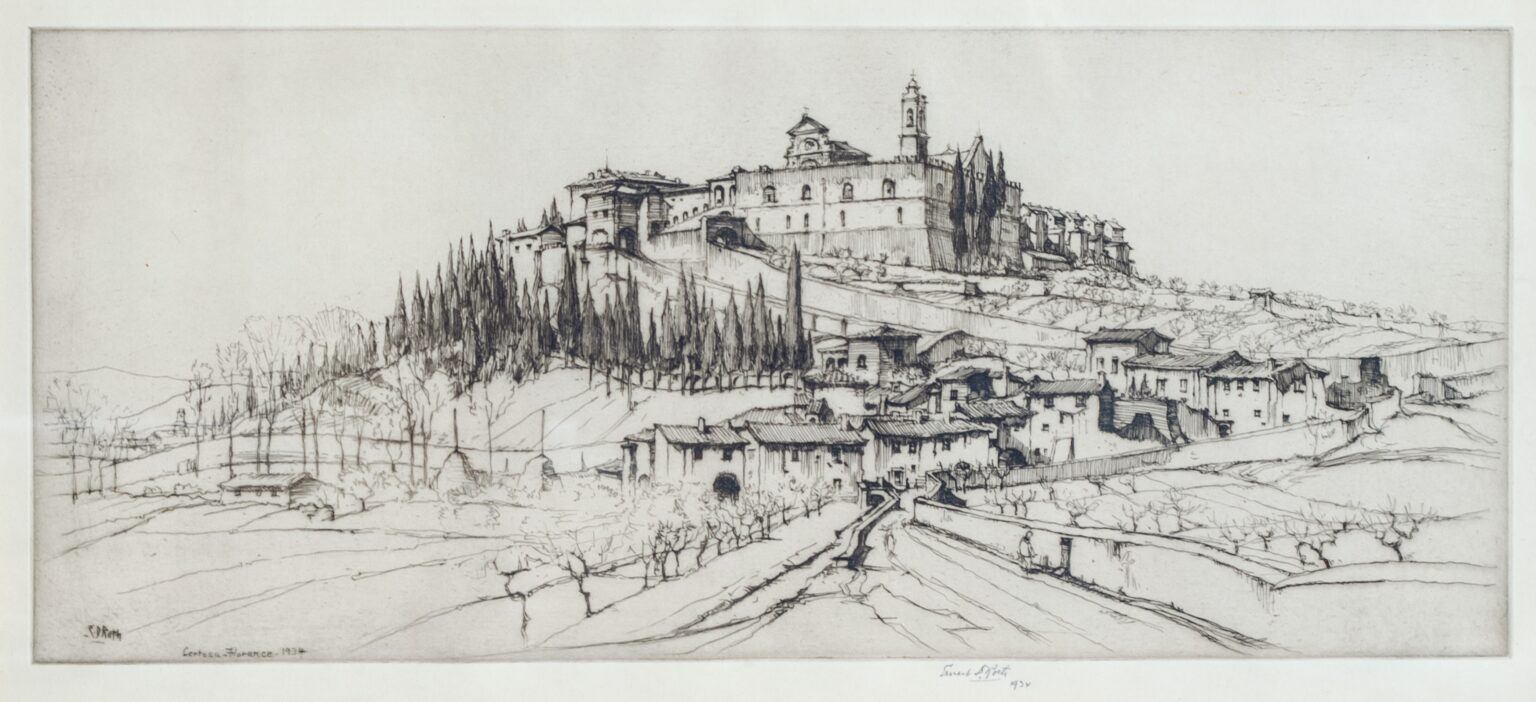
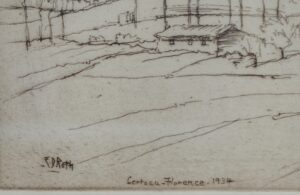
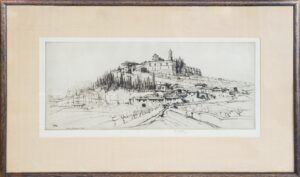
Title: Certosa Florence
Date: 1934
Condition: Good condition, stain present on right side of mat
Medium: Etching
Dimensions: framed: 13 1/2 x 21 7/8 x 1/3 in.; sight: 16 x 7 1/2 in.
Estimated Value: $500
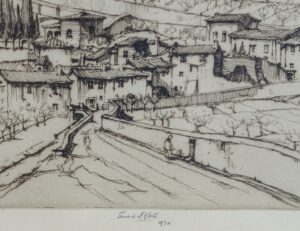
Signature/Markings: signed lower left
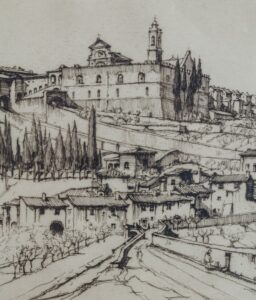
"Certosa, Florence" depicts a walled monastery that sits on a sprawling hilltop, its church facade and tall bell tower rising above long fortified walls with arched windows. A dense stand of narrow cypress trees climbs the slope in front of the buildings and gathers near the left end of the wall. At the foot of the hill, small stone houses with tiled roofs are shaded with careful hatching. In the foreground, a road forks and runs toward the viewer through open fields dotted with bare trees. A low wall along the right side where a lone figure stands beside it.
Ernest David Roth was born in Stuttgart, Germany in 1879. At the age of five, his parents emigrated to the United States, where they settled in New York City. As a boy Roth worked in a print shop, an experience that sparked his interest in art and led him to formal study. At the National Academy of Design he learned painting from Edgar Ward and George Maynard, etching from James David Smillie, and studied with F. Luis Mora at the New York School of Art.
Roth became a United States citizen in 1905 and went abroad in that same year. He spent three years in Italy, painting and etching, and in 1907 two of his prints were shown at the Venice Biennale. After a stretch back in New York, he returned to Italy and France in 1912, traveling with etcher, J. Andre Smith. The two men shared an admiration for Whistler and did much to carry his influence into the twentieth century. The city of Venice captured Roth’s attention the most, leading to about 45 etchings of the city. The First World War slowed his printmaking, but he traveled to Spain in 1921 and spent all of 1924 in Italy, a trip that yielded some of his best Venetian work.
His subjects were mostly buildings and landscapes in Venice, Seville, Segovia, and later the American places he knew, including a series of New York views in which the city’s new skyscrapers rose beside his studio. Figures rarely appear in either his prints or his paintings.
Roth was also a master printer. He pulled editions for other artists, among them John Sloan, for whom he printed roughly 3,580 etchings from 107 plates. His own career gathered recognition steadily. He held the first of many exhibitions at Frederick Keppel & Co. in New York in 1914. At the 1915 Panama-Pacific International Exposition he showed 25 etchings and received a silver medal for etching and a bronze medal for painting. The National Academy of Design elected him an Associate in 1920 and a full Academician in 1928. In 2012 a traveling exhibition and catalog, "Reflections & Undercurrents: Ernest Roth and Printmaking in Venice, 1900-1940", organized by Eric Denker, focused on his Venetian prints.
Roth's work can be found in collections held by the Museum of Fine Arts, Boston, the Art Institute of Chicago, the National Gallery of Art, the Brooklyn Museum, the Smithsonian American Art Museum, and the Delaware Art Museum, among others.
Provenance:
Private New York Collection
Exhibition History:
Publication History: