


Artist: Maker unknown
Artist Nationality: Burmese(?)
Artist Dates:
Title: Kalaga Burmese Textile
Date: c. Early 20th century
Condition: Good condition
Medium: Textile with beads
Dimensions: 21 x 37 in. framed
Estimated Value: $1,000
Signature/Markings:
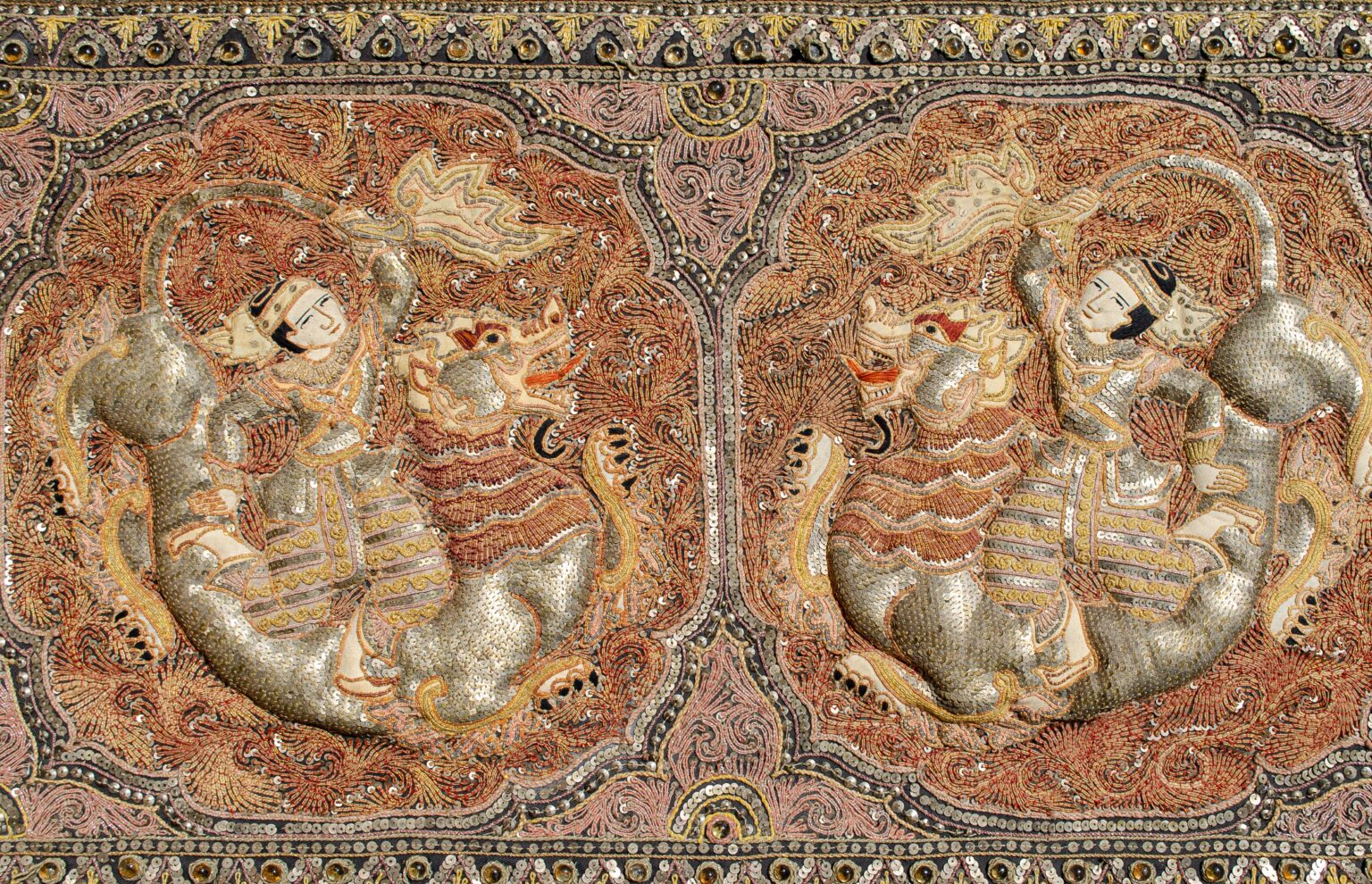
This textile presents a single motif twice in mirror image: a crowned youth in Burmese court dress riding a chinthe, the Burmese word for lion. Each rider and lion sits within a lobed cartouche framed by bands of sequins, cord scrollwork, and amber glass cabochons. The padded figures rise from the ground in low relief with thousands of hand-sewn metal sequins catching the light across the lions’ bodies and the riders’ garments. Crowned figures on kalaga, such as those depicted, usually represent a prince, a deva (celestial being), or a nat (guardian spirit). The image reads best as an emblem of royal and divine authority over the guardian lion rather than a single narrative episode. The work belongs to the kalaga tradition, a form of pictorial embroidery closely tied to the royal court and Buddhist monasteries of Upper Burma.
Kalaga embroidery took shape under the Konbaung dynasty (1752 to 1885), the last royal house of Burma. The word ‘kalaga’ means ‘curtain’ or hanging, and Burmese also call the work shwe chi doe, or gold thread embroidery. The form reached a high point at the Mandalay court of King Mindon, who reigned from 1853 to 1878. Households hung kalaga on walls, divided rooms with them, and raised them as outdoor screens at festivals, while monasteries displayed them as offerings. Subjects came from the Jataka tales of the Buddha’s past lives and from the Ramayana, with costumes drawn from court theatre. After Britain annexed Upper Burma in 1885, Mandalay workshops turned to monastic and foreign buyers.
While the maker of the present work is unknown, they are likely from Burma (Myanmar). This textile requires further research for proper identification.
Provenance:
Private New York Collection
Exhibition History:
Publication History: