Artist: Alexander Liberman
Artist Nationality: Ukrainian-American
Artist Dates: 1912-1999
Title: From Grey to Black
Date: 1962
Condition: Good condition
Medium: Acrylic on canvas
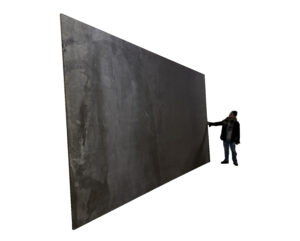
Dimensions: 115 x 183 in.
Estimated Value: 200,000-250,000
Signature/Markings:
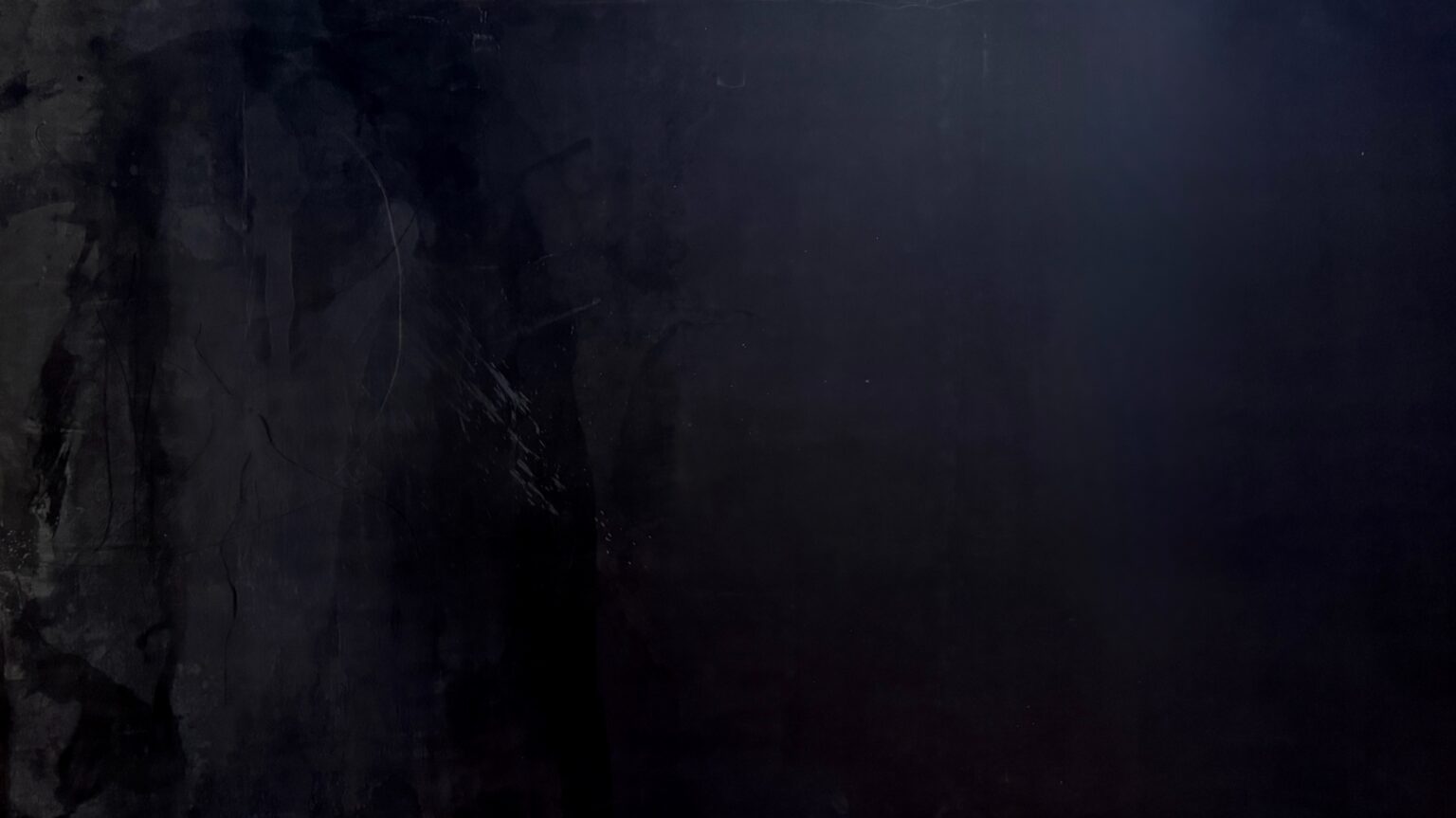
From Grey to Black (1962) marks Liberman's pivot from the precise, hard-edge circle paintings of the 1950s into expansive color-field and tonal abstraction. The 115 x 183-inch canvas is one of his largest paintings of the period and one of a small group of monumental dark color-field works (the companion Untitled, 1962, in the same archive is even larger). The painting's tonal modulation from grey at the right edge to dense black at the left builds spatial depth without composition in the traditional sense, anticipating both the architecturally-scaled tonal field of Liberman's Temple I (1963–64, Museum of Modern Art) and Green Diagonal (1964, Smithsonian American Art Museum). The catalyst for the shift, in Liberman's own account, was material as much as conceptual: "Liquitex came into my life, like a beautiful woman," he told Thomas B. Hess of his 1962 adoption of acrylics, alongside large rolls of cotton duck and a squeegee — what Liberman called "a perfect device for keeping the 'me' from getting into the picture" (Corcoran 1970 catalogue, p. 24). He explained the abandonment of hard-edge abstraction directly: "it was becoming a trick; repetitious; precision was turning into neatness; I was bored and wanted to go further." Executed the year Liberman was promoted to Editorial Director of all Condé Nast publications.
Artist Bio
Alexander Liberman (Ukrainian-American, 1912–1999) was a defining figure of twentieth-century modernism whose prolific work as a painter, sculptor, and photographer developed alongside a transformative thirty-two-year career directing the visual identity of Condé Nast Publications. Operating with equal fluency across commercial print and fine art, Liberman explored the structural possibilities of geometry and industrial materials, advancing a formal vocabulary that anticipated Minimalism and redefined postwar American public sculpture.
Born in Kyiv on September 4, 1912, Liberman spent his early childhood in Moscow before his family obtained permission from Lenin and the Politburo in 1921 to relocate to London. Raised in Paris, he studied philosophy, mathematics, and architecture before turning to painting at the École des Beaux-Arts from 1932 to 1933. At nineteen, he joined the art department of the weekly newsmagazine Vu, collaborating with photographers including Brassaï, André Kertész, and Robert Capa, and earning the Gold Medal for Design at the 1937 Exposition Internationale in Paris. In 1941, fleeing occupied France, Liberman emigrated to the United States. He joined Condé Nast as an assistant to Vogue art director Mehemed Fehmy Agha, succeeding him in 1943. Liberman became art director of all Condé Nast publications in 1960 and editorial director in 1962, a position he held until 1994, fundamentally modernizing American magazine design through high modernist aesthetics and dynamic pacing.
Concurrently, Liberman pursued a disciplined studio practice. Believing Western civilization had overlooked the visual primacy of the circle, he produced hard-edge paintings in industrial enamel and stainless steel. By suppressing gestural expression and the artist's hand, these works presaged Minimalist reduction. His 1950 painting Two Circles, now in The Metropolitan Museum of Art, was exhibited at the Solomon R. Guggenheim Museum as his sole public showing before 1960. That year, having learned welding in 1959, he debuted his sculptures at the Betty Parsons Gallery. He later affiliated with the André Emmerich Gallery and was accorded a retrospective at the Corcoran Gallery of Art in 1970.
Today, his works reside in major collections worldwide, including The Met, MoMA, the Guggenheim, the Hirshhorn, the Tate, and LACMA.
Provenance:
Estate of the Artist
Private Collection, New York
Exhibition History:
Alexander Liberman, Paintings and Sculpture, 1950 - 1970, The Corcoran Gallery of Art, courtesy of the Betty Parsons Gallery,
Washington D.C., April 19 - May 31, 1970
Publication History:
Alexander Liberman, Paintings and Sculpture, 1950 - 1970, Catalogue entry 42, pg 92 (The Corcoran Gallery of Art)