
Artist: Alphonse Legros
Artist Nationality: French-British
Artist Dates: 1837-1911
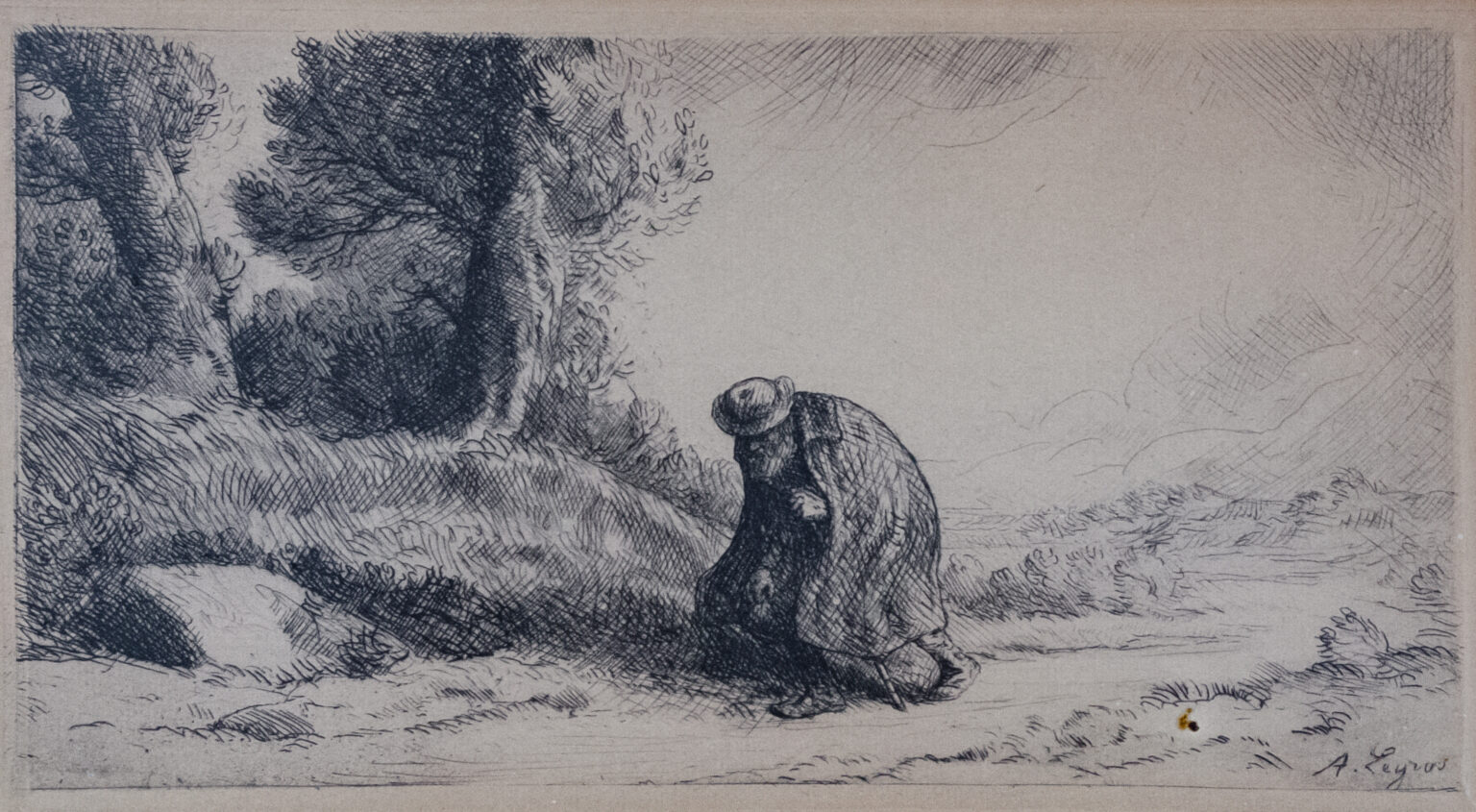
Title: A Vagabond Walking Along a Lane
Date: c. late 19th century
Condition: Accretion on lower right
Medium: Etching
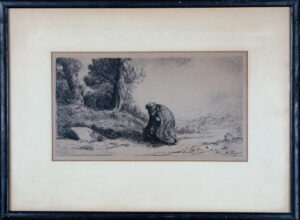
Dimensions: framed: 12.5 x 6.75 x 0.5 in. sight: 6.25 x 11 in.
Estimated Value: $1,000
Signature/Markings: Signed in the plate
About the print: This small etching exemplifies the quiet gravity and direct observation that characterize the work of Alphonse Legros. The solitary, stooped figure walking along a rural path reflects his lifelong familiarity with the peasants and landscapes of Burgundy, subjects he knew intimately from childhood visits to his relatives’ farms. The restrained palette of etched line, the soft modulation of light, and the emphasis on humble labor evoke the ethos of the Realist circle with which he was associated in Paris—artists who rejected academic sentimentality in favor of truthful, unsparing depictions of everyday life.
The composition also shows the disciplined draftsmanship and respect for antique form that he developed through his training at the Petite École and the École des Beaux-Arts. The confidently varied linework, from the dense hatching in the trees to the delicate shading of the sky, demonstrates the “simple technique” and clarity of outline he later demanded from his own students as an influential etching teacher and Slade Professor. In its combination of rural subject matter, technical concision, and contemplative mood, the print embodies both his early experiences in the French countryside and his lifelong commitment to integrity of drawing and craft.
Other editions in select museum collections:
Aberdeen Archives, Gallery & Museums, Aberdeen, UK
Art Institute of Chicago, Chicago, IL
National Gallery of Art, Washington, D.C.
Perlman Teaching Museum, Northfield, MN
About the artist: A painter, etcher and sculptor, he was born in Dijon. His father was an accountant, and came from the neighboring village of Véronnes. Young Legros frequently visited the farms of his relatives, and the peasants and landscapes of that part of France are the subjects of many of his pictures and etchings. He was sent to the art school at Dijon with a view to qualifying for a trade, and was apprenticed to Maître Nicolardo, house decorator and painter of images. In 1851 Legros left for Paris to take another situation; but passing through Lyon he worked for six months as journeyman wall-painter under the decorator Beuchot, who was painting the chapel of Cardinal Bonald in the cathedral.
In Paris he studied with Cambon, scene-painter and decorator of theaters, an experience which developed a breadth of touch such as Stallfield and Cox picked up in similar circumstances. At this time he attended the drawing-school of Lecoq de Boisbaudran (the "Petite école") where he found himself in sympathy with Jules Dalou and Auguste Rodin. In 1855 Legros attended the evening classes of the École des Beaux Arts, and perhaps gained there his love of drawing from the antique, some of the results of which may be seen in the Print Room of the British Museum.
He sent two portraits to the Paris Salon of 1857: one was rejected, and formed part of the exhibition of protest organized by Bonvin in his studio; the other, which was accepted, was a profile portrait of his father. This work was presented to the museum at Tours by the artist when his friend Cazin was curator. Champfleury saw the work in the Salon, and sought out the artist to enlist him in the small army of so-called "Realists," comprising (round the noisy glory of Courbet) all those who raised protest against the academical trifles of the degenerate Romantics
In 1859 Legros's Angelus was exhibited, the first of those quiet church interiors, with kneeling figures of patient women, by which he is best known as a painter. Ex Voto (1861), a work of great power and insight, now in the museum at Dijon, was received by his friends with enthusiasm, but it only obtained a mention at the Salon. Legros came to England in 1863 and in 1864 married Miss Frances Rosetta Hodgson. At first he lived by his etching and teaching. He then became teacher of etching at the South Kensington School of Art, and in 1876 Slade Professor at University College, London.
He was naturalized as an Englishman in 1881, and remained at University College seventeen years. His influence there was exerted to encourage a certain distinction, severity and truth of character in the work of his pupils, with a simple technique and a respect for the traditions of the old masters, until then somewhat foreign to English art. He would draw or paint a torso or a head before the students in an hour or even less, so that the attention of the pupils might not be dulled. As students had been known to take weeks and even months over a single drawing, Legros ordered the positions of the casts in the Antique School to be changed once every week. In the painting school he insisted upon a good outline, preserved by a thin rub in of umber, and then the work was to be finished in a single painting, "premièr coup."
Experiments in all varieties of art work were practiced; whenever the professor saw a fine example in the museum, or when a process interested him in a workshop, he never rested until he had mastered the technique and his students were trying their apprentice hands at it. As he had casually picked up the art of etching by watching a comrade in Paris working at a commercial engraving, so he began the making of medals after a walk in the British Museum, studying the masterpieces of Pisanello, and a visit to the Cabinet des Médailles in Paris. Legros, considered the traditional journey to Italy a very important part of artistic training, and in order that his students should have the benefit of such study he devoted a part of his salary to augment the income available for a traveling studentship. His later works, after he resigned his professorship in 1892, were more in the free and ardent manner of his early days—imaginative landscapes, castles in Spain, and farms in Burgundy, etchings like the series of The Triumph of Death, and the sculptured fountains for the gardens of the duke of Portland at Welbeck. (Bio sourced from AskArt)
Provenance:
Private New York collection
Exhibition History:
Publication History: