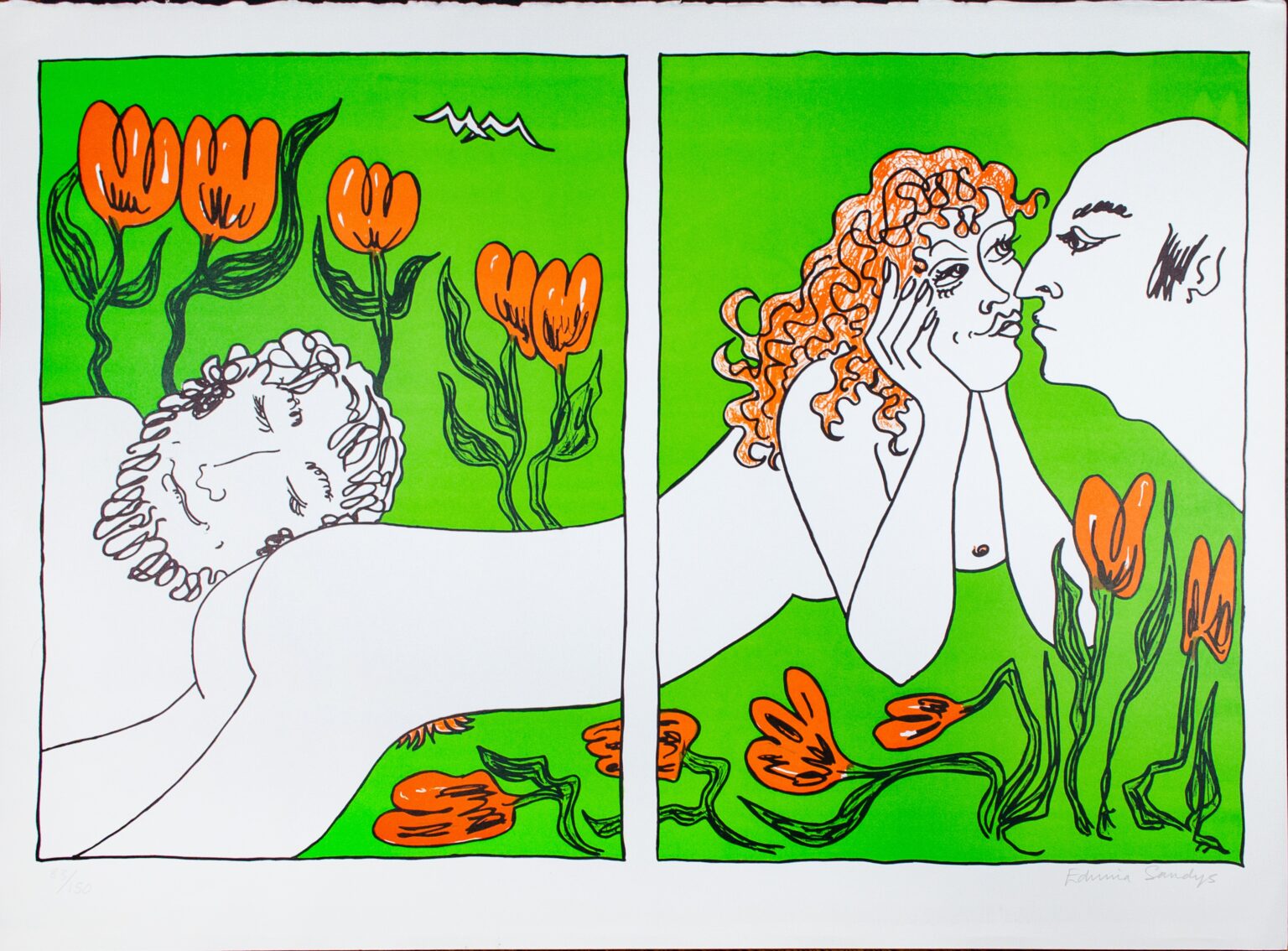


Artist: Edwina Sandys
Artist Nationality: English
Artist Dates: b. 1938
Title: Frolic on the Green
Date: 1976
Condition: Good condition
Medium: Lithograph
Dimensions: 24 x 32 in.
Estimated Value: $2,000
Signature/Markings: Signed lower right
Edwina Sandys is a British-born artist whose practice encompasses drawing, printmaking, painting, collage, and sculpture. For more than five decades, she has explored themes of gender, sexuality, faith, politics, frequently turning to the human figure to examine personal relationships and social conventions. Her visual language is distinctive for its expressive outlines, simplified forms, and vivid color.
Born in London on December 22, 1938, Sandys is the daughter of Diana Churchill and Conservative politician Duncan Sandys, and the granddaughter of Winston Churchill. Before pursuing art, she worked as a secretary, newspaper columnist, and novelist. She began making art around the age of thirty, gaining professional recognition with an exhibition of her drawings in London in 1970. She took up painting the following year, subsequently exhibiting internationally and expanding her practice to include marble carving and monumental sculpture in the mid-1970s.
Sandys’s works on paper offer a particularly revealing perspective on her practice. Her drawings and prints feature bold contours, simplified silhouettes, and contrasting areas of color to create images that are direct in her presentation, balancing playful imagery with social commentary. Humor and satire regularly temper her treatment of sensuality, gender, and human relationships. The resulting images are often playful, though their apparent simplicity can belie more pointed observations about social expectations and personal freedom. Sandys is also recognized for her public sculptures, most notably Breakthrough (1990), which incorporates sections of the Berlin Wall. Her work ranges from intimate compositions on paper to monumental installations, yet a consistent interest in the human condition connects these different forms. Rather than separating serious subjects from playful ones, she often brings them together, using familiar imagery to question established conventions. Sandys lives and works in New York City and Palm Beach, Florida.
Edwina Sandys’s works can be found in the collections of:
Tate Britain
Brooklyn Museum
Ronald Reagan Library
Franklin D. Roosevelt Presidential Library
Provenance:
Private New York Collection
H. Heather Edelman gallery, NYC
Exhibition History:
Publication History: