

Artist: Marc Chagall
Artist Nationality: Russian-French
Artist Dates: 1887-1985
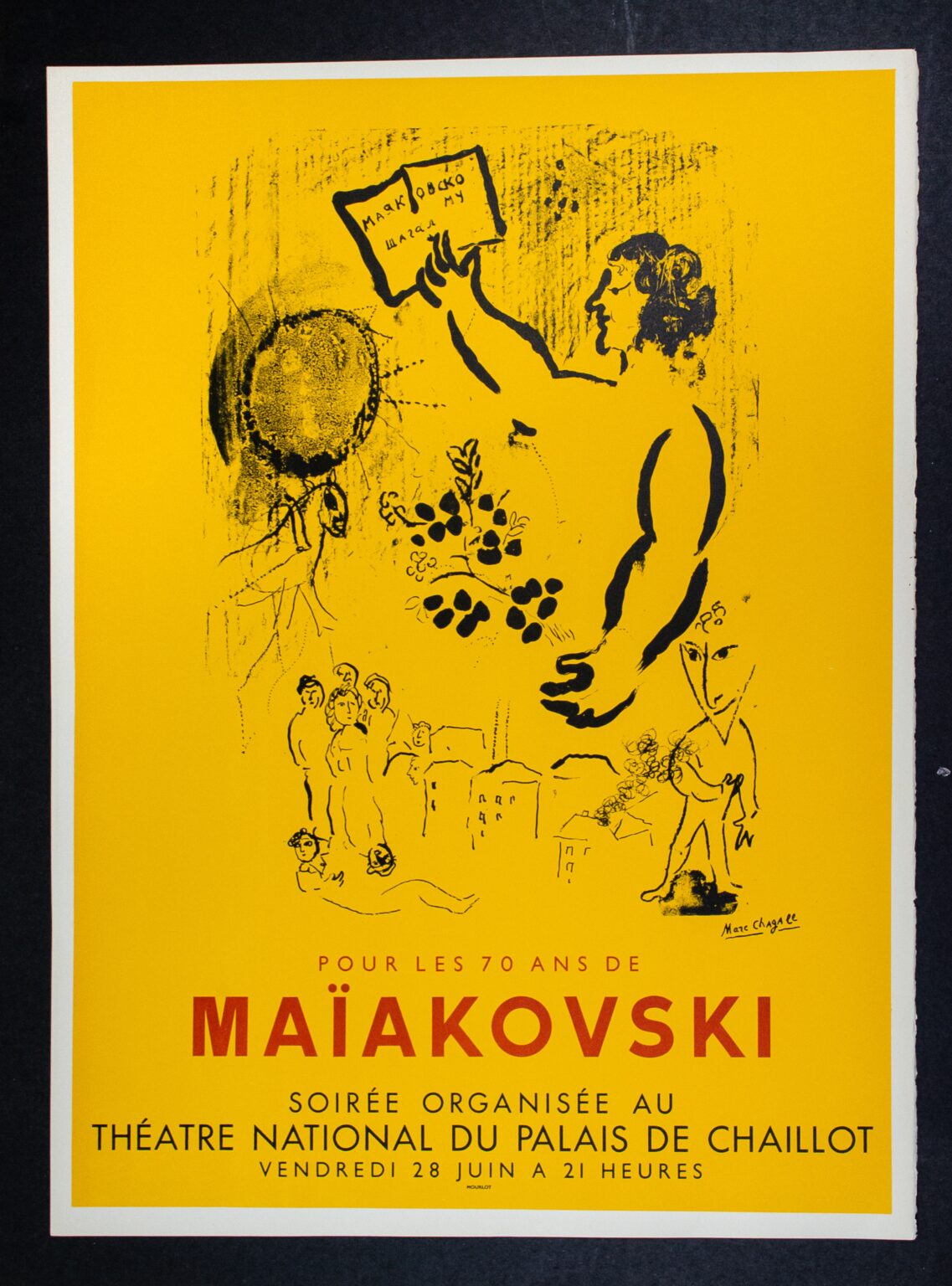
Title: Hommage à Maïakovski
Date: 1963
Condition: Good condition
Medium: Lithograph
Dimensions: 27 x 20 in.
Estimated Value: $1,750
Signature/Markings: Signed in the plate
Marc Chagall designed Hommage à Maïakovski in 1963 to mark the seventieth anniversary of the birth of Vladimir Mayakovsky, the Russian poet and his friend, who died in 1930. The poster accompanied a poetry evening devoted to Mayakovsky’s writing, and the subject reflects Chagall’s lasting ties to Russian literary and artistic culture. Printed at the Atelier Mourlot in Paris, the poster exemplifies his engagement with lithography and the circulation of modern art through printed media. Charles Sorlier's catalogue of Chagall's posters lists the work as number 45; specialist records give an edition of 500 impressions.
Artist bio
Marc Chagall was a Russian-born French artist who joined memory, folklore, and Jewish tradition to the formal freedoms of modern art. He was born Moishe Shagall on July 7, 1887, in Vitebsk, then part of the Russian Empire and now in Belarus. His family was Jewish and observant, and the rhythms of their daily and religious life stayed at the center of his work. The wooden houses of Vitebsk and the town’s fiddlers, villagers, goats, and cows returned throughout his paintings, reshaped by memory into scenes where the ordinary and the fantastic share the same space.
Chagall first studied art in Vitebsk and later in Saint Petersburg. In 1911 he moved to Paris, where Cubism and Fauvism were changing European painting. Both movements shaped Chagall’s handling of color, form, and space, yet he never belonged to either. His figures float above rooftops, ignore conventional perspective, and appear at unexpected scales. Chagall did not treat these devices as formal experiments. He used them to carry the emotional and symbolic weight of his subjects. His early paintings drew on Jewish life in Eastern Europe, mixing memories of home with scenes of courtship, prayer, and village custom. Chagall returned to Vitebsk in 1914, and the outbreak of the First World War kept him in Russia through the Revolution. In 1915, he married Bella Rosenfeld, who became one of his most constant subjects. In 1918, he became commissioner of fine arts for Vitebsk and founded an art school to bring modern training to a wider public. Disputes over the school’s direction, and rival ideas within the avant-garde led him to leave.
Chagall left Russia in 1922 and settled in France the following year. Through the 1920s and 1930s he turned increasingly to printmaking, producing etchings for Nikolai Gogol’s “Dead Souls” and Jean de La Fontaine’s “Fables.” In the early 1930s, he began a series of Bible illustrations, a long engagement with scripture and with Jewish and Christian visual traditions. As antisemitism spread across Europe, his Jewish identity placed him in growing danger. After Germany invaded France, rescue networks working to save threatened artists and intellectuals helped him reach the United States in 1941. Bella’s death in 1944 stopped his painting for months. When he resumed, he returned to themes of love, loss, exile, and faith, drawing on a visual vocabulary built over decades.
In 1948, he moved back to France and settled in the south, where his color grew brighter and fuller. His later career extended to ceramics, mosaics, stained glass, tapestries, and stage design. Major public commissions include his first stained-glass project in the United States at the Union Church of Pocantico Hills and two large murals in the lobby of the Metropolitan Opera House.
Major holders of Chagall's work include:
Musée National Marc Chagall - Nice, France
Stedelijk Museum - Amsterdam, Netherlands
MoMA - New York
Metropolitan Museum of Art - New York
Solomon R. Guggenheim Museum - New York
Art Institute of Chicago - Illinois
Provenance:
Private New York Collection
H. Heather Edelman gallery, NYC
Exhibition History:
Publication History: