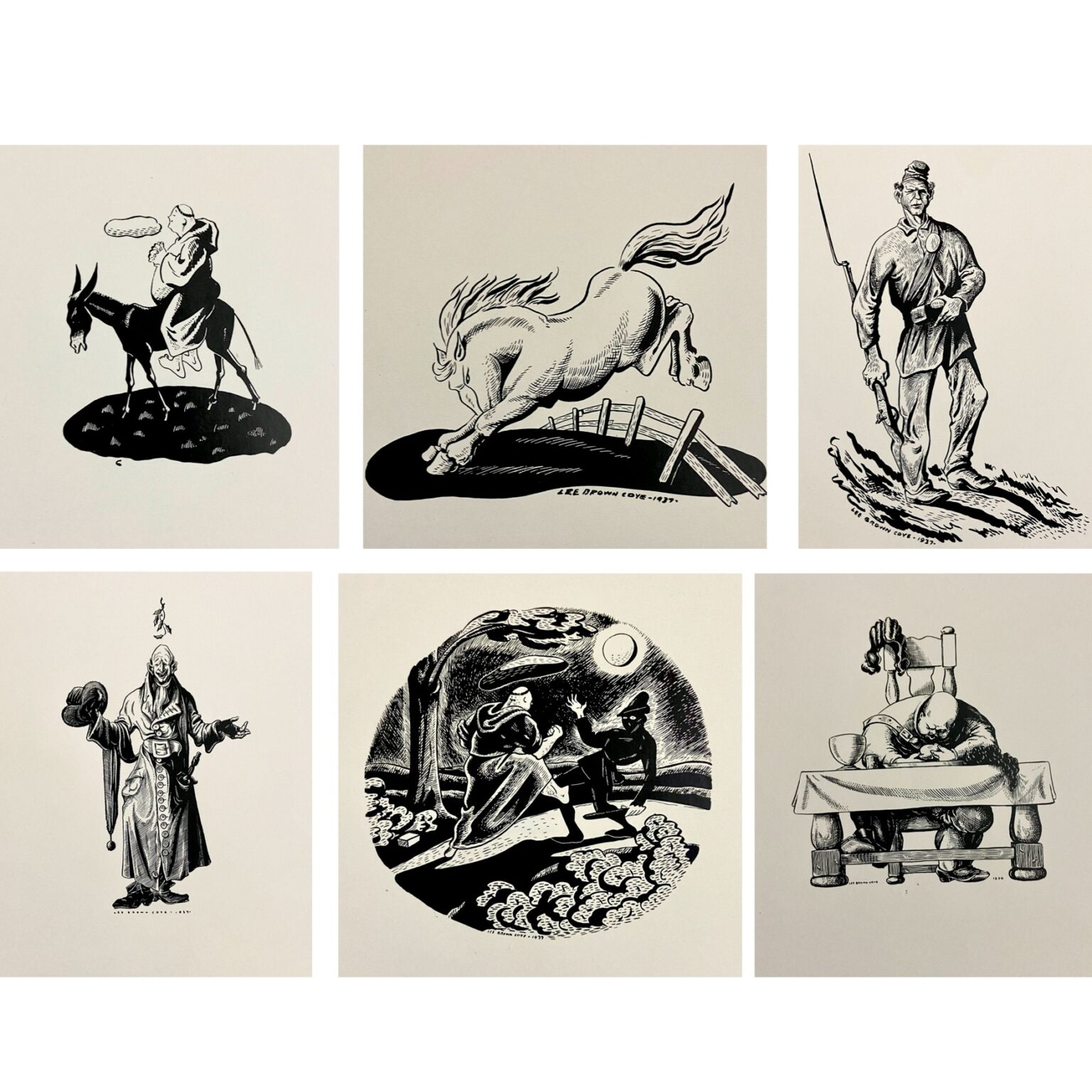



Artist: Lee Brown Coye
Artist Nationality: American
Artist Dates: 1907-1981
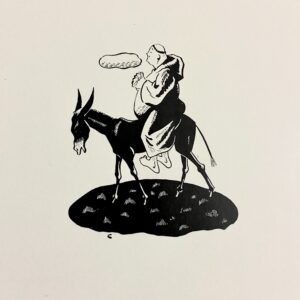
Title: Set of Six Lee Brown Coye Prints
Date: c. 1930s, printed later
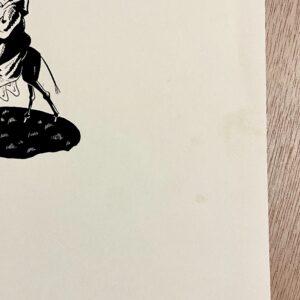
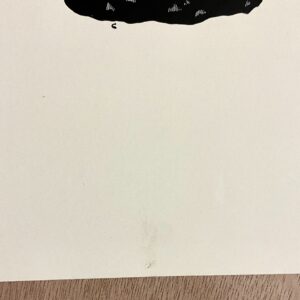
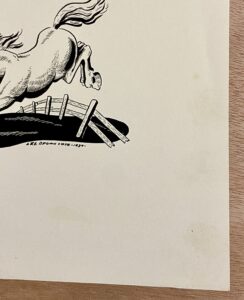
Condition: Minor surface wear (see photos)
Medium: Giclée print
Dimensions: 7.5 x 7.5 in.
Estimated Value:
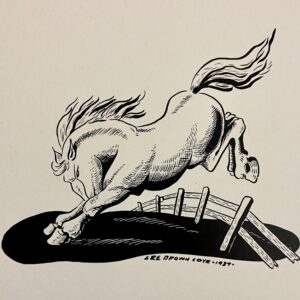
Signature/Markings: Signed and dated in the plate
About the prints:
These prints showcase Lee Brown Coye’s distinctive draftsmanship—rooted in his largely self-taught background and sharpened through work as a medical illustrator—where expressive line, anatomical precision, and slight distortions create figures that feel both lively and psychologically charged. Though Coye is best known for his later macabre illustrations for Weird Tales and Lovecraft collections, these works reveal the broad range of his early and mid-career imagery: rural scenes drawn from his lifelong life in Central New York, humorous character studies, and atmospheric nocturnes marked by signature elements such as the crescent moon. Each print carries a strong narrative impulse, reflecting his lifelong orientation toward storytelling in WPA murals, advertising work, and magazine illustration.
Even without his iconic crossed-stick motif, the prints contain hallmarks of Coye’s emerging sensibility—dynamic compositions, theatrical contrasts, and a subtle undercurrent of the uncanny. They illustrate the foundations of the imaginative, stylistically bold artist who would later win multiple World Fantasy Awards, while also emphasizing his versatility beyond the horror genre.
Other editions of this series can be found in the collection of the Colgate University Picker Art Gallery, Hamilton, NY
About the artist:
Lee Brown Coye, born in Syracuse, New York, is best known as an illustrator and painter. As a young man, he attended one semester of night art classes, but his artistic knowledge and abilities were essentially self-taught through his work and from studies of nature. His knowledge of body parts developed from studies of anatomy and work as a medical illustrator. He spent time attending operations and autopsies, thus becoming extremely familiar with the human form.
As a young man he lived in Tully, New York, and as an adult spent his entire life in the Central New York area. He and his wife, Ruth, lived in Syracuse for many years where Coye's activities included teaching adult art classes; working under the Works Progress Administration to paint a mural in the Cazenovia High School in 1934 (since destroyed); advertising for the WSYR Broadcasting System; producing a variety of commissioned works; and pursuing his own interests as an artist.
The Coyes settled in Hamilton, New York, in 1959, when Lee went to work for Sculptura, a small company that reproduced antique sculptures. The move to Hamilton allowed Coye to fulfill his ambition of returning to a small town and maintaining his own art studio.
One recurring feature in Coye's work is the motif of wooden sticks. In 1938, when Coye was living in the North Pitcher, New York, area, where he had spent much of his childhood, he encountered a curious grouping of sticks. On a walk past an abandoned farmhouse, he came across boards and pieces of wood, which had been set perpendicular to one another, surrounding the site. Neither inside nor out could Coye find an explanation for the presence of these crossed sticks. In the years following, Coye remained interested in the significance of his discovery. When he returned to the site in 1963, there was nothing left of the building or the sticks, and he never found out why they had been there or who it was that had arranged them in such a manner. Because of the strangeness of the entire experience, these forms never left Coye, and they appear in many of his paintings and illustrations.
The crescent moon was another early Coye trademark in paintings and illustrations, and the whale became a later signature motif. Coye fashioned wooden sculptures, silver pendants and pins, engravings, drawings, and a large painting of whales. One very fine example is in the SUNY Morrisville Library collection, a three-foot long pine "Moby Dick" sculpture created in 1965.
Coye's fame as an illustrator of the macabre developed as a result of his drawings for 'Weird Tales', a popular pulp magazine. From 1945 to 1952, his covers and interior work captured images of horror and the supernatural. In the 1960 s, Coye's work appeared in such magazines as 'Fantastic' and 'Amazing'. He illustrated August Derleth's horror story anthologies, 'Sleep No More', 'Who Knocks', and 'The Night Side', as well as the H. P. Lovecraft collection, '3 Tales of Horror', and Manly Wade Wellman's anthology, 'Worse Things Waiting'. In 1975 and again in 1976, Coye won the World Fantasy Award for best artist.
Although Lee Brown Coye is best known for his fantasy and horror illustrations, his artistic output for fifty years covered a broader spectrum. He was a watercolor, oil, and egg tempera painter, a muralist, a sculptor, a photographer, a silversmith, and an able builder of models and dioramas. From rats and beetles and disfigured bodies, to whales, mythic figures and landscapes, Coye's subjects are as diverse as the media in which he worked. His work was executed with craftsmanship, and exhibits the originality that sprang from his renowned imagination and sense of humor. Coye created paintings, sculpture, and jewelry that are as beautiful as his illustrations are macabre.
Coye's work is represented in numerous collections including the Metropolitan Museum of Art in New York, the Everson Museum in Syracuse, the Onondaga County Historical Society, Colgate University, the SUNY Morrisville Library, SUNY Oswego, Syracuse University, and private collections.
Written and submitted May 2002 by Tammra Rayfield. Her information is based upon an article she wrote entitled "Lee Brown Coye: Illustrator and Artist", in The Mage, Summer 1985, with additional material supplied by Robert Coye. (Bio sourced from AskArt)
Provenance:
Private Virginia Collection
Exhibition History:
Publication History: